ECCV 2026
DiTailed: Ensuring Visual Object Consistency in Text-Image-to-Image Flow Matching Models
1{ftaioli,dfcoelho,imlkhv,ralcover,jgrande,virfer}@amazon.com
2artur.bekasov@faculty.ai
1{ftaioli,dfcoelho,imlkhv,ralcover,jgrande,virfer}@amazon.com
2artur.bekasov@faculty.ai
Despite remarkable progress in text-guided image editing, generative models frequently fail to preserve visual object consistency, defined as the preservation of a subject's key attributes throughout the editing process.
We address this limitation through three contributions.
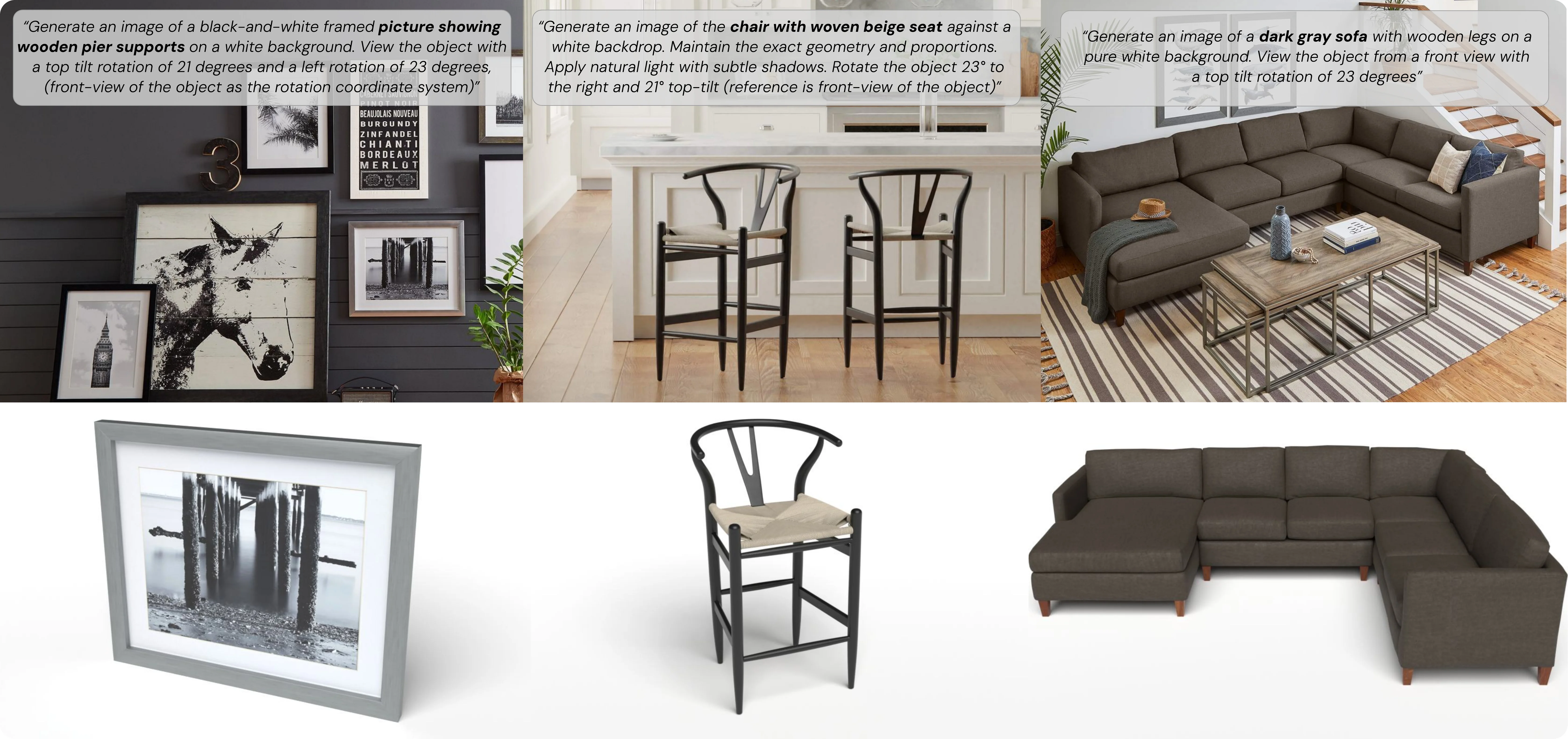
First, we introduce ABO-Edit, a dataset specifically designed to study object consistency, comprising over 12,000 triplets of source images, editing prompts, and high-quality target images rendered from artist-designed 3D assets, with multi-view coverage and human-verified quality control.
Second, we uncover an overlooked property of image-editing rectified flow models: the conditioning embedding space, not directly supervised during training, encodes a prediction of the final generated image even at high noise levels.
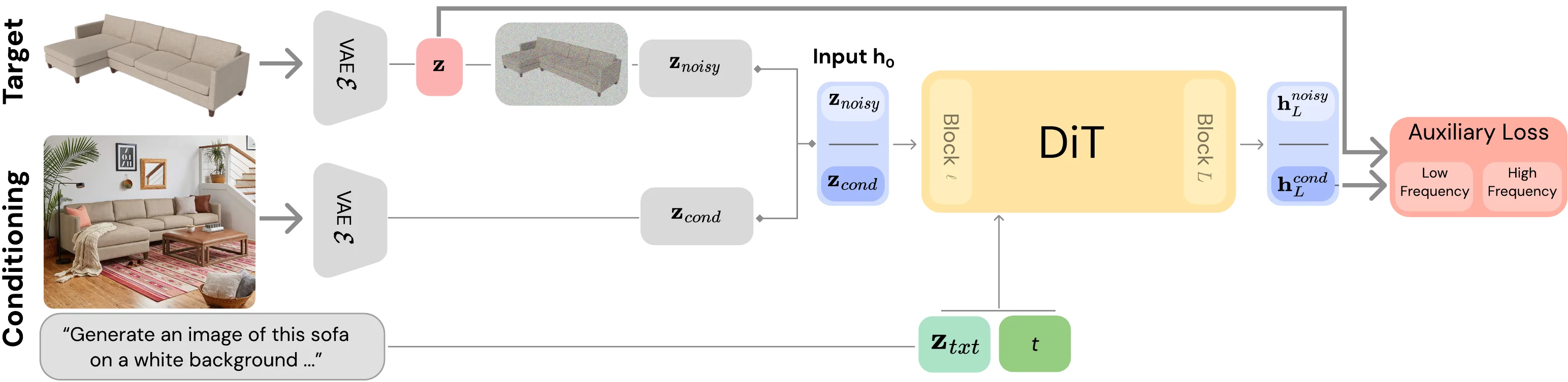
Third, exploiting this finding, we propose FlowMirror, a parameter-free auxiliary loss that supervises this conditioning embedding space.
Without architectural changes, our method improves generation quality across several metrics over baselines.
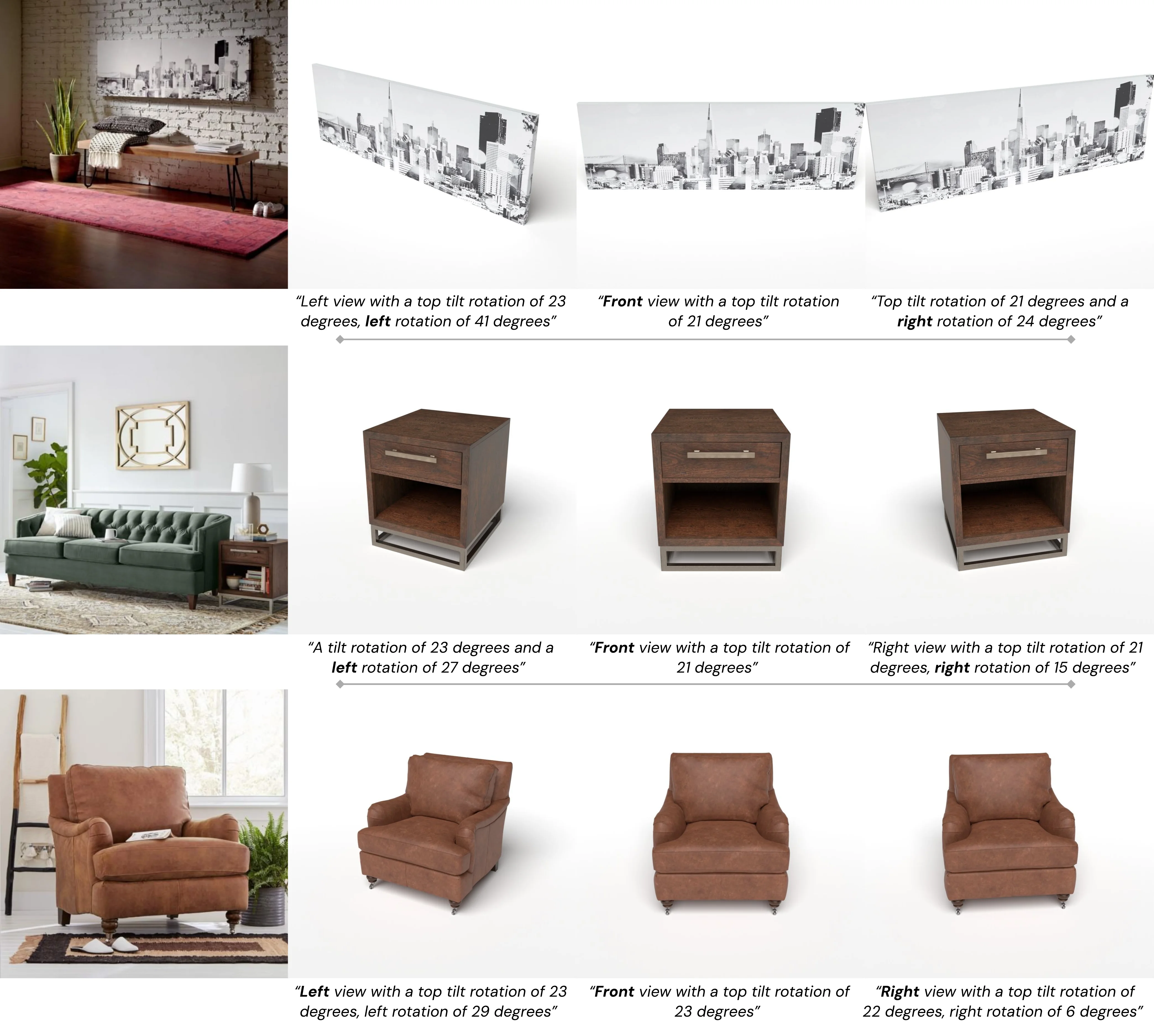
12,000+ triplets of source images, editing prompts, and high-quality targets rendered (with Blender) from artist-designed 3D models. Each target covers three views of the same object (multi-view coverage) and each sample is human-verified.
See dataset →We uncover that rectified flow models encode a prediction of the final output in the conditioning embedding space, even at high noise levels.
Explore insight →A parameter-free auxiliary loss that supervises the conditioning embedding space. No architecture changes, negligible compute overhead, consistent improvements across metrics.
View method →Even with straightforward editing prompts specifying background removal or basic rotations given an image, state-of-the-art models frequently fail to maintain visual object consistency: geometry is distorted, textures are altered, and fine-grained details disappear.

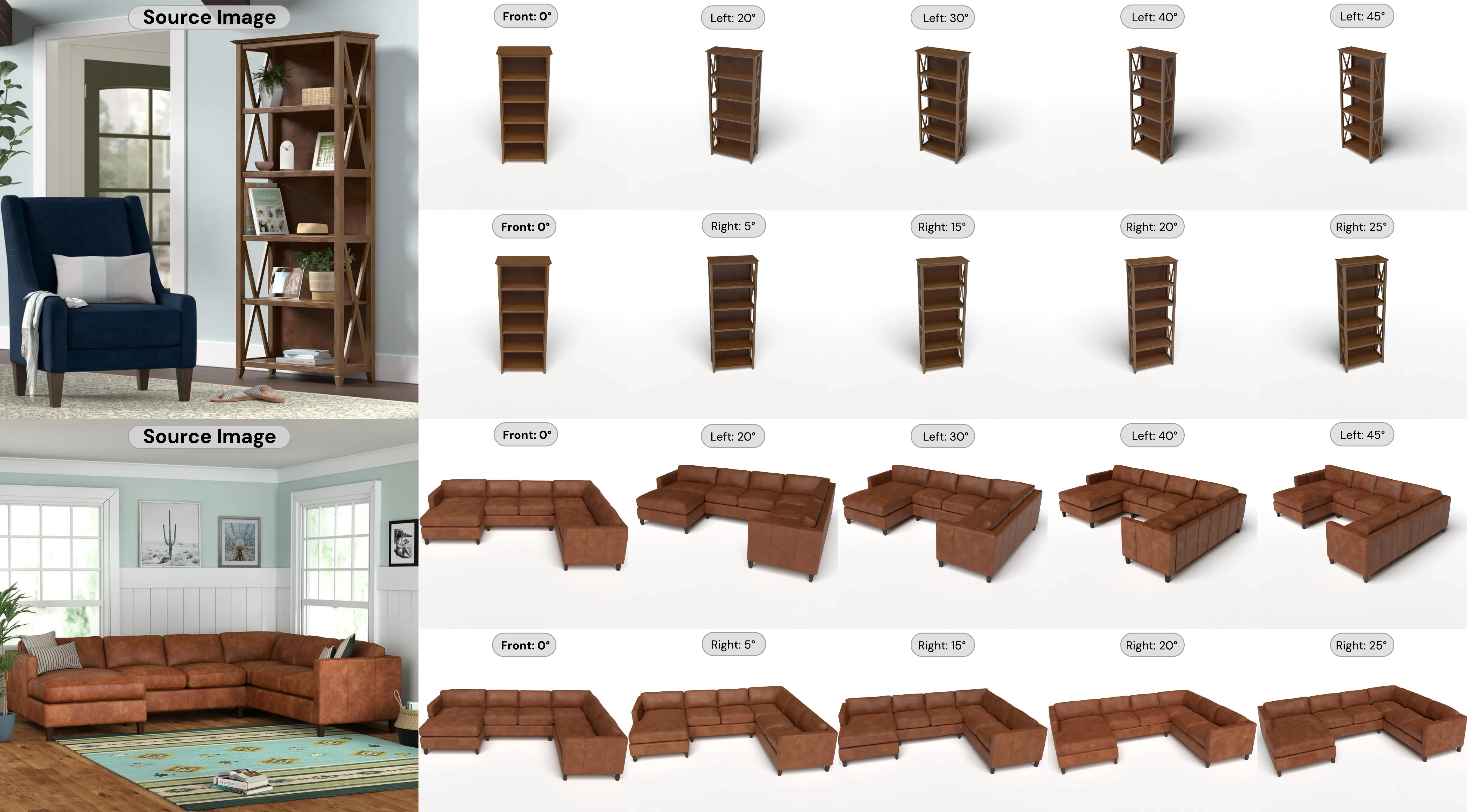
ABO-Edit is built on the Amazon Berkeley Objects (ABO) dataset and contains over 12,000 triplets of source lifestyle images, editing prompts with degree-level rotation angles, and ground-truth targets rendered from artist-designed 3D models using Blender at 1024×1024 resolution. Each product is rendered from three viewpoints (left, front, right), enabling evaluation of visual consistency under orientation changes. All samples are validated through human quality control via crowdsourcing.
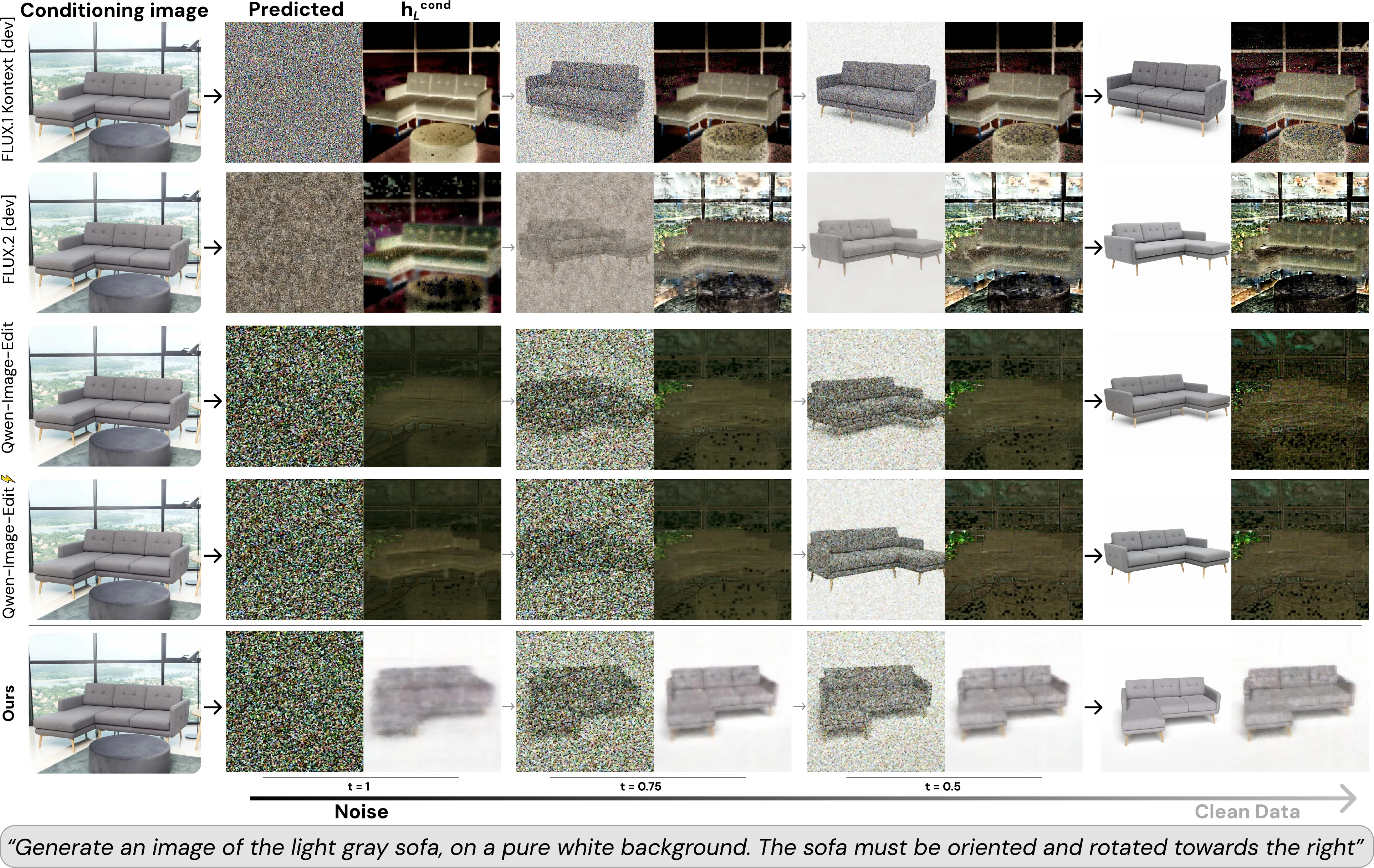
In rectified flow editing models, the predicted velocity is computed solely from the noisy input, while the conditioning output hLcond is discarded at inference. Yet this representation remains coupled to the generation process: it participates in attention computations across all transformer layers and receives gradients during training. This raises a question: what information does it encode, and how does it evolve during denoising?
We decode hLcond using the VAE decoder at various timesteps and discover two distinct behavioral patterns. Models in the FLUX family maintain representations of the conditioning image throughout denoising. In contrast, Qwen-based models encode a prediction of the final generated image in hLcond, even at high noise levels (t ≈ 1) — a property that is never explicitly supervised during training.
Remarkably, this latent prediction exhibits higher similarity to the final output than the velocity estimate at early denoising steps, providing insight into the effective number of inference steps required for convergence, as shown in the following Figure:
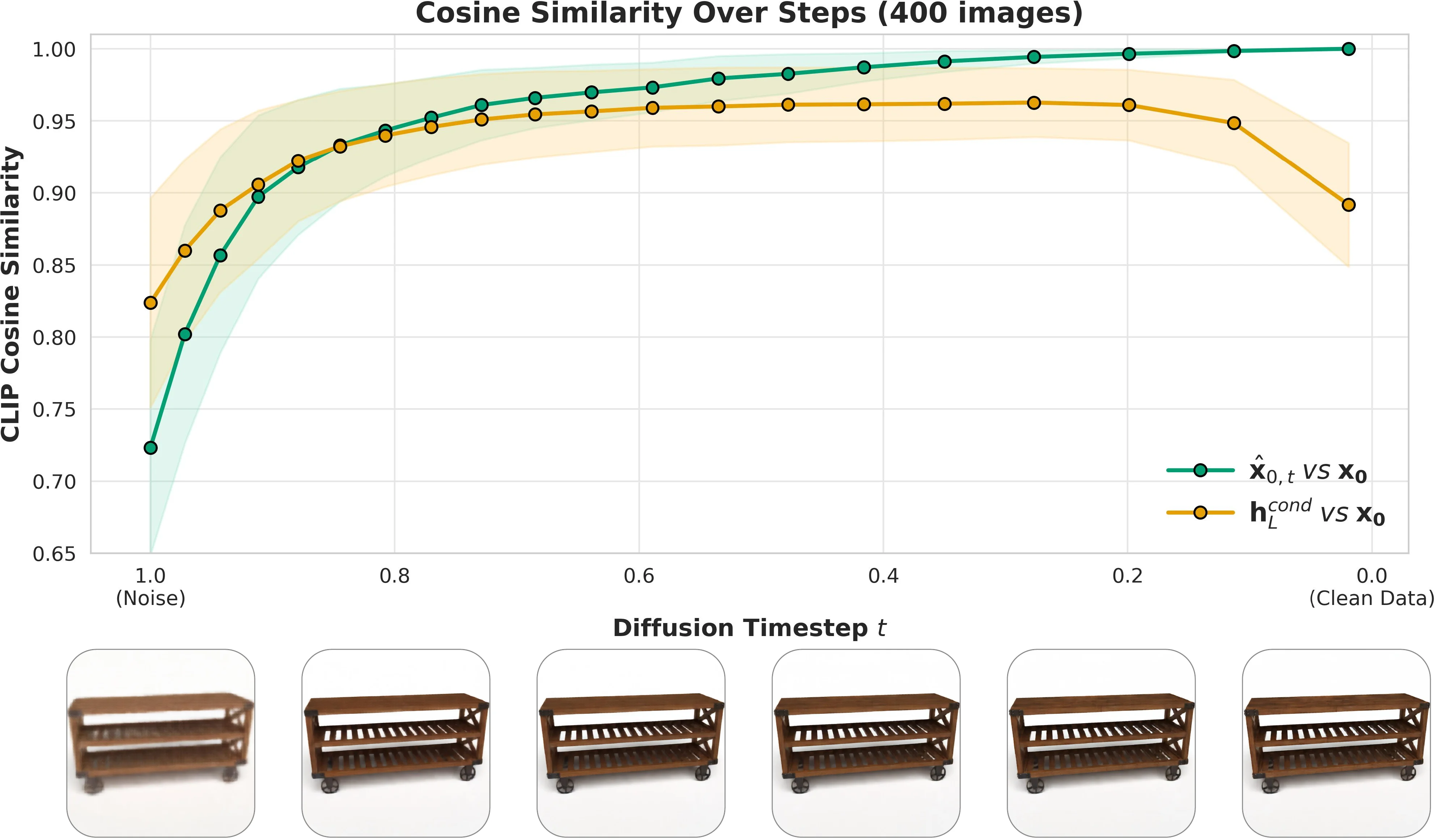
The observations above reveal that certain model families naturally encode the final output in hLcond, and that these predictions stabilize early in denoising. Leveraging these insights, we hypothesize that explicitly supervising hLcond to match the target amplifies this beneficial behavior: it encourages the model to form accurate output representations early, while providing auxiliary gradient signal without additional parameters.
We thus propose a parameter-free multi-scale auxiliary loss that supervises the conditioning output using the VAE latent of the target image. Operating entirely in latent space (without invoking the decoder), the loss decomposes into high-frequency (detail preservation) and low-frequency (structural) components via a Laplacian-pyramid decomposition. Crucially, this incurs negligible computational overhead and requires no architectural changes.
Fine-tuning on ABO-Edit enables precise angular control (mean error < 2.5°) while maintaining visual consistency across generated views.
FlowMirror consistently improves metrics across two architectures (FLUX and Qwen) with lower variance, indicating more stable optimization.
| Method | FID ↓ | SSIM ↑ | PSNR ↑ | LPIPS ↓ | CLIP ↑ | DINOv2 ↑ |
|---|---|---|---|---|---|---|
| Zero-shot baselines | ||||||
| Kandinsky 5.0 | 88.60 | .644 | 9.14 | .579 | 83.55 | 56.74 |
| FLUX.1 Kontext | 59.32 | .789 | 12.17 | .345 | 90.76 | 78.14 |
| FLUX.2 | 53.67 | .803 | 12.80 | .320 | 92.66 | 83.67 |
| Qwen-2511 | 64.23 | .805 | 12.73 | .336 | 89.17 | 77.83 |
| Qwen-2509 | 57.66 | .818 | 12.76 | .312 | 91.95 | 82.30 |
| Fine-tuned on ABO-Edit | ||||||
| FLUX.1 Kontext | 31.68 | .883 | 18.62 | .149 | 96.20 | 90.99 |
| + FlowMirror (ours) | 31.26 | .883 | 18.67 | .148 | 96.30 | 91.25 |
| Qwen-2509 | 26.48 | .893 | 19.64 | .112 | 97.21 | 93.98 |
| + FlowMirror (ours) | 25.91 | .894 | 19.79 | .111 | 97.17 | 93.94 |
All fine-tuned models trained 3× with different seeds. Mean reported. Best per section in highlighted rows. Human evaluation: our method preferred 4.4 percentage points more often than baseline.